Why the Right Ingredients Matter for Bladder Health
Not all supplements are created equal — and nowhere is that more true than in the urinary health category. Most products targeting bladder control or UTI prevention use one of two approaches: they either flush bacteria out (D-Mannose, cranberry) or suppress symptoms with pharmaceutical-grade compounds. Neither rebuilds the underlying protective system.
Research published in the American Journal of Obstetrics and Gynecology identified something more fundamental at work in women with recurring urinary issues: a depleted urinary and vaginal microbiome. Specifically, the Lactobacillus strains that should dominate a healthy urinary tract were significantly reduced — and in women who had completed multiple antibiotic courses, they were nearly absent.
FemiCore was formulated around one core insight: the most effective way to support long-term bladder health is to restore the specific bacterial strains that make the urinary environment inhospitable to pathogens in the first place — not simply to manage the symptoms when that environment breaks down.
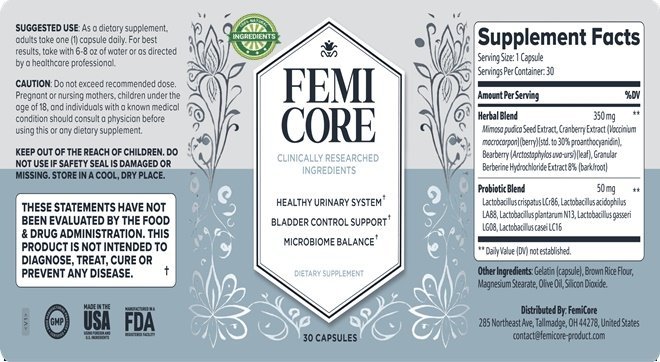
That's why every ingredient in FemiCore was selected based on published clinical research demonstrating its specific role in urinary or vaginal microbiome health. Below is a complete breakdown of what's inside, what each ingredient does, and why it earned a place in this formula.
The Five Lactobacillus Strains
The probiotic core of FemiCore consists of five Lactobacillus species chosen for their demonstrated activity in the urinary and vaginal tract — not the gut. This distinction matters enormously. Generic probiotic blends typically use gut-optimized strains that show limited ability to colonize urinary tissue. The strains below colonize differently, produce different protective compounds, and target the actual sites of dysfunction.
Lactobacillus crispatus
If there is one ingredient that defines the FemiCore formula, it is Lactobacillus crispatus. This organism is the dominant species in the vaginal flora of women who enjoy consistent bladder control and low rates of urinary infection. It performs two protective functions simultaneously: producing lactic acid to maintain vaginal pH between 3.8 and 4.5, and generating hydrogen peroxide to create a directly antimicrobial environment.
When pH stays within this optimal range, E. coli — the bacterium responsible for the vast majority of urinary tract infections — struggles to survive, let alone replicate. Women with depleted L. crispatus levels lose this pH-dependent shield, creating the conditions for both overactive bladder symptoms and recurrent infection.
Lactobacillus acidophilus
Lactobacillus acidophilus operates through the gut-vaginal axis — a bidirectional communication pathway linking intestinal microbiome composition to vaginal and urinary flora. By supporting a healthy intestinal environment, L. acidophilus creates downstream conditions in which protective urinary strains can establish and sustain themselves.
Critically, clinical studies show this strain actively reduces the capacity of E. coli to adhere to urinary tract epithelial cells. Given that E. coli accounts for 80 to 90 percent of all urinary tract infections, this mechanism represents one of the most direct anti-infection benefits in the formula.
Lactobacillus plantarum
One of the primary challenges with probiotic supplementation is ensuring that viable organisms actually reach their intended destination. Many strains are neutralized by stomach acid before colonization can begin. Lactobacillus plantarum is one of the most acid-tolerant species available, demonstrating significantly higher survival rates through the gastrointestinal tract than comparable organisms.
Its inclusion in FemiCore also reflects specific clinical evidence for urinary health: a 2022 trial showed that L. plantarum supplementation produced meaningful reductions in both the frequency and severity of episodes in patients with recurring urinary tract infections — making it among the best-studied strains for this specific application.
Lactobacillus gasseri
Lactobacillus gasseri has been studied specifically for its capacity to establish and maintain colonization in vaginal epithelial tissue — a property that distinguishes it from gut-targeted strains. It produces its own repertoire of antimicrobial compounds and works in direct cooperation with L. crispatus to sustain the acidic pH environment that resists bacterial vaginosis and urinary dysbiosis.
Research identifies L. gasseri as particularly effective at suppressing the overgrowth of anaerobic organisms associated with vaginal microbiome disruption — the same disruptions that frequently precede urinary tract infections in women with recurring episodes.
Lactobacillus casei
Where the other four strains focus on colonization and direct antimicrobial activity, Lactobacillus casei contributes a different layer of protection: immune system modulation and microbiome diversity. A more diverse and immunologically supported microbiome is a more resilient one — less likely to collapse under the pressure of stress, hormonal fluctuation, dietary changes, or antibiotic exposure.
This strain effectively extends the durability of the microbiome restoration process. It helps convert short-term colonization by the other four strains into a stable, self-sustaining protective ecosystem — the difference between temporary improvement and lasting change.
The Four Botanical Cofactors
Probiotics alone cannot do the full job. The botanicals in FemiCore serve as environmental support — creating the conditions in which protective bacteria can thrive, directly inhibiting pathogenic activity, and providing the urinary tract with acute support during the weeks it takes for stable probiotic colonization to establish itself.
Cranberry Extract (Standardized Proanthocyanidins)
Cranberry extract appears in dozens of urinary health supplements, but most formulations fail to deliver it at a clinically meaningful dose. The active compounds responsible for cranberry's protective effect — proanthocyanidins (PACs) — prevent E. coli from binding to the epithelial lining of the urinary tract. Without adhesion, bacteria cannot colonize, replicate, or trigger an immune response.
FemiCore uses a concentrated cranberry extract standardized to deliver PACs at the dose validated in research to produce this anti-adhesion effect. This is the threshold most consumer-grade cranberry products never reach, which explains why they provide inconsistent or short-lived results.
Bearberry (Uva Ursi)
Bearberry leaf, known botanically as Arctostaphylos uva-ursi, has been used in traditional herbal medicine for urinary tract support for centuries. The active mechanism is well understood: bearberry contains arbutin, a glycoside that the body converts into hydroquinone within the urinary tract. Hydroquinone functions as a natural antimicrobial agent, reducing bacterial load in the urine without the systemic disruption caused by antibiotic treatment.
Clinical trials have confirmed bearberry's ability to reduce the discomfort and duration of lower urinary tract symptoms. When combined with cranberry extract, the two botanicals address bacterial adhesion and bacterial viability through complementary mechanisms — making their pairing in FemiCore a deliberate choice, not coincidental.
Granular Berberine
Berberine is the ingredient in FemiCore with the most direct relevance to bladder control symptoms — specifically urgency, frequency, and involuntary leakage. Research published in the Journal of Ethnopharmacology demonstrated that berberine improves neurogenic contractile response in the bladder detrusor muscle — the smooth muscle responsible for the involuntary contractions that cause urgency and urge incontinence.
Beyond its effect on bladder muscle, berberine also displays selective antimicrobial activity. It inhibits the growth of pathogenic bacterial species while demonstrating a preferential supportive effect on certain beneficial strains — making it one of the few ingredients in this formula that addresses both the muscular symptoms and the microbial environment simultaneously.
Mimosa Pudica
The inclusion of Mimosa pudica reflects an understanding that vaginal and urinary microbiome health cannot be separated from the broader internal environment — particularly the gut. The gut-vaginal microbiome axis means that disruptions in intestinal flora directly influence the composition and stability of urogenital flora.
Mimosa pudica supports intestinal integrity and creates conditions in which beneficial bacteria can establish and sustain populations systemically. By addressing the digestive foundation, it reinforces the work of the five probiotic strains throughout the body — not only in the urinary tract but in the interconnected ecosystem that supports it.
How All 9 Ingredients Work Together
Each ingredient in FemiCore targets a distinct layer of urinary and vaginal microbiome health. Their value multiplies when they operate in concert — which is precisely how the formula was designed.
🛡 Layers 1–2: pH Defense
L. crispatus and L. gasseri jointly maintain the acidic vaginal pH that prevents pathogenic bacteria from establishing a foothold in the urinary tract.
🔒 Layer 3: Adhesion Blocking
Cranberry PACs prevent E. coli from binding to urinary tract walls, while L. acidophilus reinforces this barrier at the epithelial level through immune modulation.
⚡ Layer 4: Active Antimicrobial
Bearberry's hydroquinone conversion and berberine's selective inhibition create an active antimicrobial layer that reduces existing bacterial load without eliminating protective flora.
🌱 Layer 5: Systemic Resilience
L. plantarum, L. casei, and Mimosa pudica build and sustain the broader ecosystem health that keeps the entire protective system functioning under real-world stress.
The Complete Protection Framework
Together, these ingredients address every major vulnerability in the urinary microbiome defense system:
- Restoring the dominant protective strain depleted by antibiotics and hormonal change
- Blocking bacterial adhesion before infection can begin
- Modulating bladder muscle activity to reduce urgency and leakage
- Providing acute botanical support while probiotic colonization establishes
- Reinforcing the gut-vaginal axis that sustains urogenital flora long-term
FemiCore Ingredients vs. Generic Probiotics
Understanding what makes FemiCore's ingredient selection distinctive requires comparing it directly to the standard probiotic products most women reach for first.
| Ingredient / Strain | Generic Probiotic | FemiCore | Relevant Benefit |
|---|---|---|---|
| L. crispatus | ✕ Rarely included | ✓ Cornerstone strain | Primary pH defense, hydrogen peroxide production |
| L. gasseri | ✕ Not standard | ✓ Included | Vaginal colonization, antimicrobial compounds |
| L. plantarum | ✕ Gut-focused dose | ✓ Acid-resistant form | UTI frequency reduction (clinical trial data) |
| Cranberry extract (PACs) | ✕ Underdosed or absent | ✓ Standardized clinical dose | E. coli adhesion prevention |
| Berberine | ✕ Not included | ✓ Granular form | Bladder muscle regulation, urgency reduction |
| Bearberry (Uva Ursi) | ✕ Not included | ✓ Included | Natural antimicrobial via arbutin conversion |
| Gut-vaginal axis support | ✕ Gut-only focus | ✓ Mimosa pudica | Systemic microbiome resilience |
The core distinction is one of target specificity. Generic probiotics are formulated to support digestion, and they do that well. FemiCore is formulated to restore the urinary and vaginal microbiome — a physiologically distinct environment that requires different strains, different botanical cofactors, and a different understanding of what "success" looks like.
Frequently Asked Questions
About FemiCore Ingredients
Lactobacillus crispatus is the cornerstone ingredient because it is the dominant protective organism in a healthy vaginal microbiome and the strain most strongly associated with bladder control in clinical research. Without adequate L. crispatus, the pH-based protective environment breaks down — making every other defense significantly less effective.
FemiCore is formulated with natural-origin ingredients. The formula does not include unnecessary artificial additives. Each ingredient was selected for a specific clinical reason — there are no filler components included to meet a capsule size target or reduce formulation cost.
Strain selection in FemiCore accounts for acid tolerance. L. plantarum in particular demonstrates among the highest gastric acid survival rates of any commonly used Lactobacillus species. Taking FemiCore with food further buffers the strains as they transit through the stomach, improving the proportion that reach the intestinal tract viable and ready to colonize.
Berberine has been studied for extended-period use across multiple clinical contexts and is generally considered safe at the doses used in FemiCore. Women taking medications for blood glucose management or blood pressure should consult their healthcare provider before starting, as berberine may interact with these drugs. Pregnant or nursing women should also speak with a provider first.
The botanical components — cranberry extract, bearberry, and berberine — begin providing urinary support from the early days of supplementation. The probiotic strains require more time: most women notice changes in bladder urgency and comfort around weeks 3 to 4, as colonization becomes sufficient to shift pH and produce protective compounds consistently. Significant and lasting improvement in the overall pattern of bladder control and UTI frequency typically becomes apparent between weeks 6 and 8 of daily use.